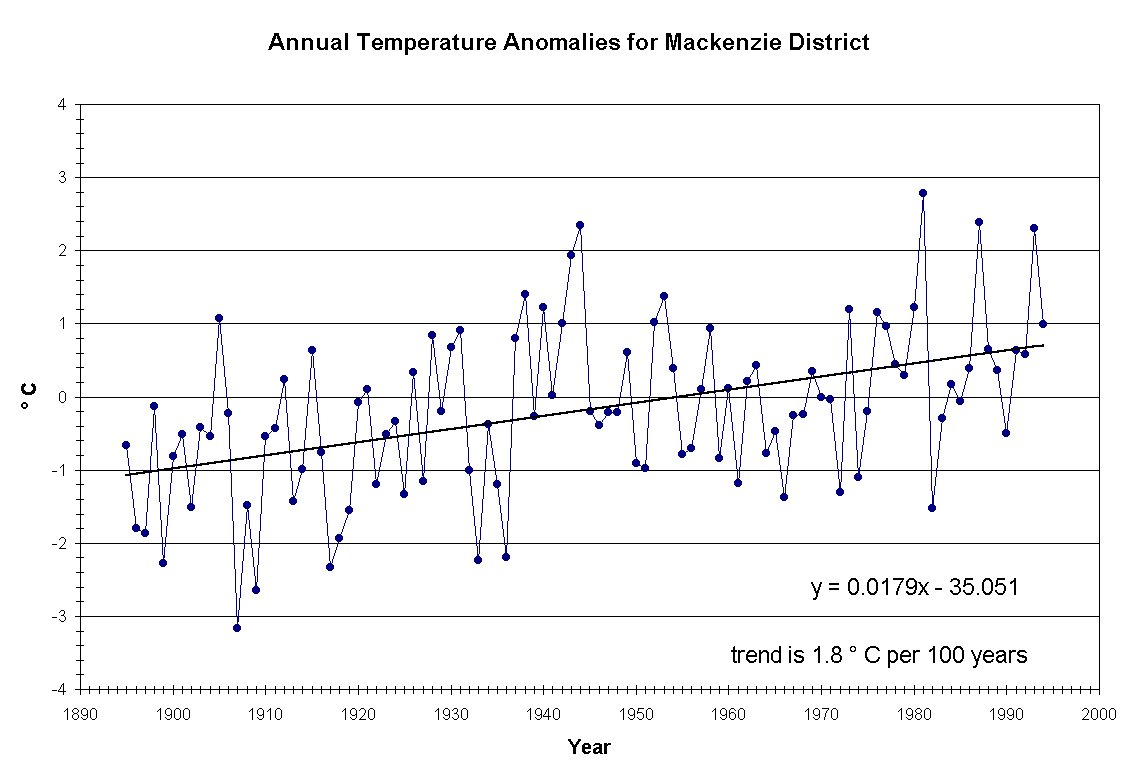
There are many processes occurring within the Mackenzie Basin that affect its water and energy cycles. During some years, the magnitudes of some of the Basin characteristics are substantially different from their long-term averages.
In this section, a list of years with anomalous conditions over the Mackenzie Basin is being established. Suggestions and comments can be made by clicking here.
Year         Brief Comment                               Contributor
1972    Cold autumn, early freezeup                      Tom Agnew
1974    Cold autumn, early freezeup                      Tom Agnew
1979    Warm autumn, early freezeup                      Tom Agnew
In this section, background information in regards to anomalous years is being summarized.
1. The following information was provided by Tom Agnew:
Climate Monitoring Division of AES has yearly and seasonal
temperature anomaly data and maps for Canada and the Jones dataset
is available on CD-ROM if a rigorous analysis of anomalous years
is required. The temperature anomaly record for the Mackenzie
district (a figure to be added) indicates a trend towards warmer
temperatures of about 1.5 °C per century. Over the last 25
years of the record, 1972 and 1982 were the two coldest years.
They were exceptional years for other parts of Canada and the
northern hemisphere reflecting the strong connection between temperature
and atmospheric circulation. 1972 is recognized as the coldest
year for all of the Canadian Arctic not just the Mackenzie and
the anomalous atmospheric circulation in 1982 is attributable
to the fact that it was the strongest ENSO and PNA year on record
(see Quiroz, Mon. Wea. Rev., 1983, 1685-1705). Juxtaposed to 1982
is the exceptionally warm 1981 year. This again reflects the abrupt
change in circulation caused by ENSO. How anomalous these years
are in terms of precipitation and runoff is not clear. Work that
was done in the Canadian Arctic Islands indicates that anomalous
temperature seasons or years do not correlate that well with anomalous
precipitation. Also, within-season fluctuations are hidden in
this record. For example, a study which looked at climate change
and the Beaufort Sea ice regime found that the summer of 1989
year was exceptionally warm and was mentioned as a very warm summer
and the end of a warm decade in the Mackenzie. However it does
not show up as exceptional in the annual anomaly record. Again
precipitation was not considered.