Historical Background
The MAGS scientific program has evolved since 1989 when
the first workshop was held to discuss how Canada might contribute to the Global
Water and Energy Cycle Experiment (GEWEX) organized by the World Climate
Research Programme (WCRP). Most of the early Canadian GEWEX research was
conducted by government scientists working under the auspices of the Environment
Canada Green Plan. The current government-university partnership began in
earnest in 1996 when university researchers funded by the Natural Sciences and
Engineering Research Council (NSERC) joined with the Environment Canada
scientists to begin the first phase of the Mackenzie GEWEX Study. A second,
five-year phase of the MAGS project began in 2000 with renewed NSERC funding and
government support. Much of the evolution of MAGS is summarized
in the MAGS Historical Milestones
document.
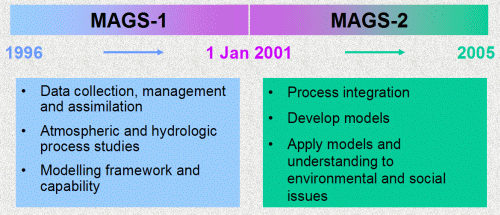 The fundamental
goal of MAGS through Phase 1 and Phase 2 has been to improve our understanding
of the water and energy cycle of the Mackenzie River Basin. While its main goal
has remained constant, there has been a shift in emphasis from basic data
collection and process research in Phase 1 to an emphasis on modelling and
prediction in Phase 2. The MAGS Science and Implementation Plan
(September 12, 1995) outlines the scientific goals articulated for MAGS-1, the first
phase of the Mackenzie GEWEX Study that began in 1996. The MAGS-2 Scientific Programme Framework
outlines the goals and objectives of the second phase of the project that began
in 2000. The fundamental
goal of MAGS through Phase 1 and Phase 2 has been to improve our understanding
of the water and energy cycle of the Mackenzie River Basin. While its main goal
has remained constant, there has been a shift in emphasis from basic data
collection and process research in Phase 1 to an emphasis on modelling and
prediction in Phase 2. The MAGS Science and Implementation Plan
(September 12, 1995) outlines the scientific goals articulated for MAGS-1, the first
phase of the Mackenzie GEWEX Study that began in 1996. The MAGS-2 Scientific Programme Framework
outlines the goals and objectives of the second phase of the project that began
in 2000.
Research Strategy
The essential features of the MAGS research strategy are to:
-
Standardize background information characterizing the Mackenzie Basin
-
Adequately observe the needed features characterizing the water and energy cycles of the Mackenzie Basin
-
Develop Basin-scale representations of the water and
energy cycles based upon observations and data assimilation techniques
-
Carry out needed studies of the critical processes affecting the Basin water and energy cycles
-
Develop atmosphere-surface-hydrology modelling capability to represent these cycles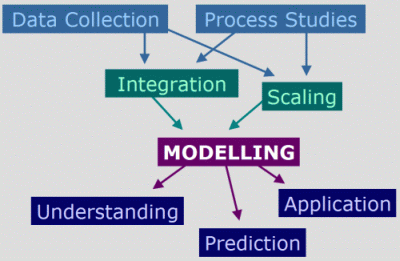
-
Assess the ability of our regional climate model to replicate the critical water and energy cycles of the Basin when driven by observed large scale forcing and improve the model until it does replicate these cycles
-
Develop the capability for seasonal or so prediction of Basin water resources with the use of predicted large scale fields
.....and, of course
-
Understand the climate system of the Mackenzie Basin and its possible alteration through anthropogenic effects
.....and
-
Ensure that the ongoing progress within the study is made available to interested groups and individuals across the country and the world
Annual Progress
As one of the GEWEX Hydrometeorology
Panel (GHP) continental scale hydrometeorology experiments, the Canadian program
contributes to an international scientific program. The GHP anticipates marking
the conclusion of its program in 2005 by a statement similar to the following:
We have demonstrated that it is possible to predict changes in water resources (including discharge into the Arctic Ocean) and surface moisture on time scales of seasonal to annual as an integral part of the climate system.
This can only be achieved through international cooperation
and, as one measure of the progress of the Canadian GEWEX program towards meeting our
national and international commitments, a simple statement is issued each year
in conjunction with our Science Workshop.
Our progress towards the realization of the long-term statement is shown through the following annual statements.
-
November, 2003: The statement arising from the ninth MAGS workshop (Montreal) is:
At the mid-point of MAGS-2, we see the completion of major projects initiated during MAGS-1, the advance of research in the integration, scaling and modeling themes, the continuance of research collaborations and networking at the grass root levels, as well as the maturation of users/application activities. We are initiating transferability activity and assessments of regional climate sensitivity in the context of global climate change scenarios.
-
November, 2002: The statement arising from the eighth MAGS workshop (Jasper) is:
In year 2 of MAGS-2, we see the completion of some major projects initiated during MAGS-1, the advance of research in the integration, scaling and modelling themes, the flourishing of research collaborations and networking at the grass root level, as well as the beginning of users/application activities.
-
November, 2001: The statement arising from the seventh MAGS workshop (Hamilton) is:
MAGS has successfully completed the transition to a second, 5-year phase. This included such specific activities as focused integration and scaling workshops, the publication of special journal edition on the 94-95 water year, a synthesis article on MAGS-1 scientific achievements, and planning of a transferability test over the Saskatchewan River basin. MAGS is on target with regard to its overall scientific plan and is well-positioned to initiate the next phases of research in the scaling, integration and model development themes, and to support the international GEWEX effort.
-
November, 2000: The statement arising from the sixth MAGS workshop (Saskatoon) is:
A plan for bringing MAGS 1 to a successful completion is being finalized and activities for moving into MAGS 2 are being established. A MAGS 1 synthesis article is being prepared and it will illustrate the realization of our process, model framework and data objectives. MAGS 2 is being launched through specific activities such as focused integration and scaling workshops and planning of a transferability test over the Saskatchewan River basin.
-
November, 1999: The statement arising from the fifth MAGS workshop (Edmonton) is:
All components of the overall strategy continue to progress. In particular, special measurements were made of many critical atmospheric, surface and hydrological parameters during CAGES. Basin-scale coupled hydrological-surface models have been run and deficiencies in our overall modelling capability are being identified. The first collective study of a full water year is nearing completion. As well, data products are being produced and are being utilized, and a collective CAGES analysis strategy is being developed. A plan is also being prepared to bring the first phase of MAGS to a successful conclusion.
-
November, 1998: The statement arising from the fourth MAGS workshop (Montreal) is:
All components of the overall strategy are progressing. Special measurements of many critical variables are being made and our enhanced water year study (CAGES) is underway, although there are still significant problems in our observational datasets. Progress is being made at understanding critical surface, hydrological and atmospheric issues affecting the basin's climate system. Basin-scale atmospheric/surface/hydrological models are being run and capabilities and deficiencies are being identified and recommendations for addressing these are being considered. Collective studies over full water years are underway to address the full, interacting climate system. Data management systems are in place and functioning. Activities have now commenced to produce dedicated issues of scientific journals and to map out our future activities and priorities.
-
November, 1997: The statement arising from the third MAGS workshop (Toronto) is:
All components of our overall strategy are underway. Special measurements of several critical variables have been and continue to be made and progress is being made in the use of remote sensing information. Plans for further observations have advanced, although there are many difficulties to overcome. We are assessing the water budgets using observations and models, we are better understanding the roles played by many phenomena on the Basin's climate system, we are carrying out many model studies, and we are assessing the capabilities of our regional climate model. Our data management guidelines are being improved and we, as part of our strategy, have set out to conduct joint studies of some water years.
-
March, 1997: The statement arising from the second MAGS workshop (Saskatoon) is:
All components of our overall strategy have started. Assessments of the water budgets of the Mackenzie Basin are well underway, energy studies have been started, and plans to improve our measurement of critical variables have progressed substantially. We have identified the key processes, we have carried out several background climatologies, we are improving the representation of physical processes in our models, and we have started to assess the ability of our climate model to represent the Basin's climate system. Our archiving systems are in place and we, as part of our strategy, will focus on collective studies of appropriate water years.
-
November, 1995: The statement arising from the first MAGS Workshop (Toronto) is:
Preliminary assessments of the water budgets of the Mackenzie Basin, as well as initial energy studies, have been carried out, but critical variables have not been measured adequately. We are completing the identification of key processes, we are carrying out background climatologies, and we are improving the representations of physical processes in our models.
|